
Sources and testimonies
Plutarch's treatise On Isis and Osiris
A priest of Delphi explains the myth of Osiris to a priestess: the fullest ancient account of the god's passion and one of the keys through which the Greeks read Egypt.
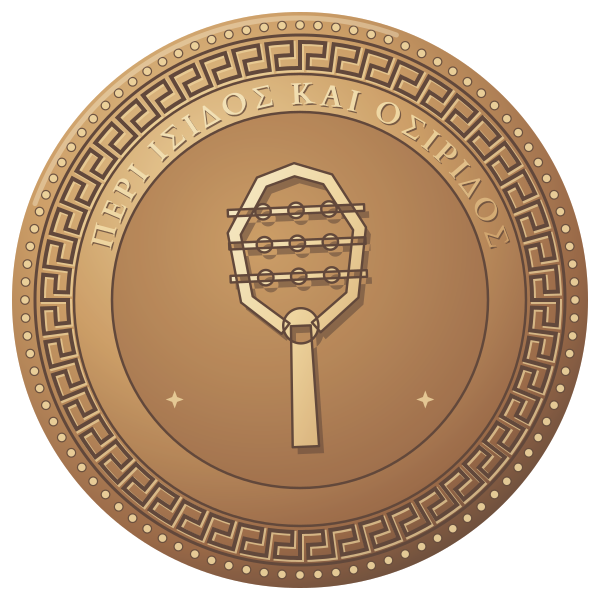
Plutarch of Chaeronea, who died after 119 AD, served for decades as a priest of Apollo at Delphi. Among his moral works is a treatise dedicated to Clea, a priestess of the Thyiads at Delphi and an initiate in the rites of Osiris. It is the ancient text that tells the myth of Isis and Osiris at length, and the one that most shaped the Western image of sacred Egypt.
The myth
Osiris reigns over Egypt and teaches humankind agriculture and laws. His brother Typhon, the Egyptians' Seth, lures him by a trick into a precious chest, seals it and throws it into the Nile. Isis searches for it for a long time and finds it at Byblos, enclosed in the trunk of a tree that had become a column of the royal palace. Typhon discovers the body and cuts it into fourteen pieces, scattered across the country; Isis recovers them one by one, except the phallus, eaten by fish, and that is why so many shrines of Osiris arose. Horus, the son, finally fights Typhon. Egyptian sources know these episodes, but only in fragments: the continuous narrative is Plutarch's.
Many readings of one myth
Plutarch does not merely tell the story. He presents and discusses the interpretations of his day: Osiris as the Nile and fertilising moisture, Typhon as drought and the salt sea; Osiris as the moon, with his twenty-eight years of reign; Isis and Osiris as great daimones who became gods. The reading he prefers is philosophical and Platonic: Osiris is the principle of order and of the good, Isis the nature that receives and desires it, Typhon the disordered and violent part of the soul and of the world.
Rites, garments and perfumes
The treatise is full of details about the cult. The priests wear linen, shave their heads and avoid certain foods such as fish. Three perfumes are burned in the temples each day: resin in the morning, myrrh at noon and, in the evening, kyphi, a blend of sixteen ingredients that Plutarch describes as able to calm the soul and encourage dreams. He also explains the sistrum, the sacred rattle of Isis, whose sound was meant to drive Typhon away.
The veil of Isis
The most famous passage is the inscription Plutarch attributes to the statue of Athena-Isis at Sais: "I am all that has been, that is and that will be, and no mortal has ever lifted my veil." From that sentence grew the image of veiled Nature that the sage seeks to unveil, taken up by Schiller, Novalis, the Freemasons of the eighteenth century and nineteenth-century literature.
Why read it
On Isis and Osiris is a bridge between the Egypt of the temples and Greek philosophy, and evidence of how Egyptian cults were lived in the Roman world, the same world in which the mysteries of Isis and the novel of Apuleius take place.
Watch the video
Sources and further reading
- Plutarch, On Isis and Osiris (Moralia 351C-384C)
- J. G. Griffiths, Plutarch's De Iside et Osiride (1970)
- P. Hadot, The Veil of Isis. An Essay on the History of the Idea of Nature (2006)
- Herodotus, Histories II
Read next
Apuleius' Metamorphoses
The Golden Ass, the only Latin novel to survive complete: Lucius' fall, the tale of Cupid and Psyche and Book XI, the most vivid account we have of an initiation into the mysteries of Isis.
The Orphic gold tablets
Thin gold leaves placed in graves from the fifth and fourth centuries BC onwards: instructions for the soul in the afterlife, between the spring of forgetting and the lake of Mnemosyne.

The Orphic Hymns
Eighty-seven prayers in verse attributed to Orpheus, each with its own incense to burn: the hymn book of a community of initiates in the Roman imperial age.
