
Sources and testimonies
The Orphic gold tablets
Thin gold leaves placed in graves from the fifth and fourth centuries BC onwards: instructions for the soul in the afterlife, between the spring of forgetting and the lake of Mnemosyne.
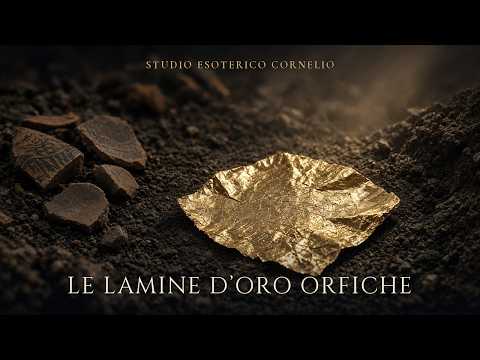
They are sheets of gold as thin as paper, a few centimetres long, folded and laid beside the dead. A few lines of Greek are incised on them: directions for the road and phrases to be spoken before the guardians of the underworld. Some dozens are known, from southern Italy, Greece and Crete, dating from the late fifth century BC down to Roman times. They are the most direct texts we have about the hopes of the initiates.
The Hipponion tablet
The oldest and most complete was found in 1969 at Vibo Valentia, ancient Hipponion, in the grave of a woman buried around 400 BC. The text presents itself as the work of Mnemosyne, Memory, and explains what to do after death. On the left the soul will find a spring beside a white cypress: it must not go near it. Further on is the cold water flowing from the lake of Mnemosyne, watched by guardians. To them it must say: "I am a child of Earth and of starry Heaven; I am parched with thirst and I am dying: give me quickly the cool water that flows from the lake of Mnemosyne." Then the soul may walk the sacred road together with the other initiates and Bacchic worshippers.
Memory against forgetting
The heart of the message is memory. Whoever drinks at the first spring forgets, and with forgetting the cycle of births begins again; whoever remembers their divine origin can escape it. It is the same image Plato uses at the end of the Republic, in the myth of Er, with the plain of Oblivion and the river Lethe. The tablets show that the idea was not only philosophy but religious practice, entrusted to a precious object.
Thurii and Pelinna
The graves of Thurii, in Calabria, have yielded tablets with different formulas: the dead woman declares that she comes "pure from the pure" before the queen of the underworld, and is answered that from a mortal she has become a god. An enigmatic phrase, "a kid, I fell into milk", must have been a ritual password. In 1985 two ivy-leaf shaped tablets were found at Pelinna, in Thessaly: "Now you have died and now you have been born, thrice blessed, on this day. Tell Persephone that Bacchius himself has set you free." Here the link with Dionysus is explicit.
Orphic or Bacchic?
By tradition scholars call them "Orphic", yet the texts name Persephone, Dionysus and the bakchoi, not Orpheus. Today they are usually seen as documents of groups of Dionysian initiates who shared ideas attributed to Orpheus: the soul as a divine spark imprisoned in the body, purity as the condition for returning to the gods. How widespread the myth of the Titans who killed the child Dionysus already was, the myth from which humankind would have inherited an ancient guilt, is still debated.
Reading them today
The tablets are kept in several museums: the Hipponion leaf in the museum of Vibo Valentia, the Petelia tablet, with its little case, in the British Museum. Read together they tell the same journey every time: thirst, the fork in the road, the right word to say. They are the material counterpart of what we know of Orphism and of the mysteries of Dionysus.
Watch the video
Sources and further reading
- G. Pugliese Carratelli, Le lamine d'oro orfiche (2001)
- F. Graf - S. I. Johnston, Ritual Texts for the Afterlife (2007, 2nd ed. 2013)
- A. Bernabé - A. I. Jiménez San Cristóbal, Instructions for the Netherworld (2008)
- G. Zuntz, Persephone (1971)
- Plato, Republic X 621a-c
Read next
Apuleius' Metamorphoses
The Golden Ass, the only Latin novel to survive complete: Lucius' fall, the tale of Cupid and Psyche and Book XI, the most vivid account we have of an initiation into the mysteries of Isis.
The Orphic Hymns
Eighty-seven prayers in verse attributed to Orpheus, each with its own incense to burn: the hymn book of a community of initiates in the Roman imperial age.
The Derveni Papyrus
The oldest European book to survive, saved by chance from a funeral pyre in Macedonia: a philosophical commentary on a poem of Orpheus about the birth of the gods.
