
The cults
Orphism
Orpheus, the singer who moved the stones, and a religious movement that taught the immortality of the soul: from the gold tablets of Magna Graecia to the Derveni papyrus.
Orpheus was the singer above all others: his lyre tamed wild beasts, bent the trees, halted rivers. When he went down to Hades to win back his bride Eurydice, he moved even the gods of the dead, but he lost her by turning round to look at her. Torn to pieces by the women of Thrace, his head went on singing as it floated on the waters. Around this legendary figure the Greeks built a whole religious movement, which we call Orphism.
A book, not a sanctuary
Unlike Eleusis, Orphism had no central temple and no official priesthood. It lived on books: poems attributed to Orpheus, theogonies, hymns, ritual instructions. In the Republic Plato pokes fun at wandering priests who knocked on rich men's doors with “a heap of books of Musaeus and Orpheus”, promising purifications for a fee, for the living and for the dead. These were the orpheotelestai, the professionals of the rite.
The body as a prison
At the heart of Orphism lies a doctrine of the soul. According to a pun that Plato attributes to the followers of Orpheus, the body (sôma) is a tomb (sêma) in which the soul pays for an ancient fault. A story known above all from late authors explains which one: the Titans devoured the infant Dionysus and Zeus burned them to ashes with his thunderbolt; from their soot humankind was born, carrying within it both a Titanic and a divine part. Scholars still argue about how old this version is, but the idea of a divine soul held prisoner is already clearly present in the fifth century BC.
From this followed the “Orphic life”: abstaining from meat, wearing linen, avoiding certain pollutions. Euripides has Theseus sneer that his son Hippolytus feeds on soulless food and plays the bacchant with Orpheus as his master.
The gold tablets
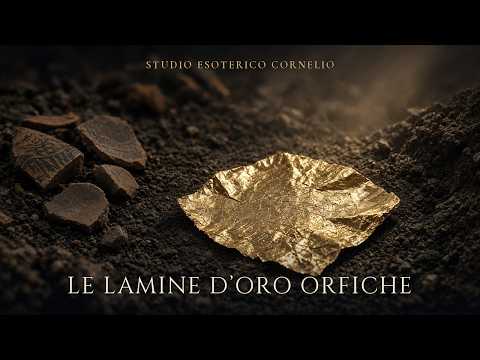
The most moving evidence comes from graves. In Magna Graecia, in Crete and in Thessaly, thin gold tablets have been found, folded and placed beside the dead, with instructions for the journey into the afterlife. The oldest and longest comes from Hipponion, today's Vibo Valentia, discovered in 1969 in a woman's grave of the late fifth century BC.
The text describes a real map of the underworld. To the right of the house of Hades there is a spring by a white cypress: the souls of the dead drink from it, but the initiate must not go near. Further on he will find the cool water flowing from the lake of Mnemosyne, Memory, watched over by guardians. To them he must speak the formula: “I am a child of Earth and of starry Heaven”, and ask to drink. Having drunk memory, he will walk the sacred road along which the other initiates and glorious bacchants also go.
Other tablets, from Thurii, put proud words in the mouth of the dead — “I come pure from the pure” — and announce a transformation: from a man you have become a god. It is the reverse of Lethe, the river of forgetting: the initiate is saved by remembering.
The Derveni papyrus
In 1962, near Thessaloniki, a charred roll was found among the remains of a funeral pyre: the Derveni papyrus, the oldest European book to have come down to us, from the fourth century BC. It contains an allegorical commentary on a theogonic poem attributed to Orpheus, read in the light of natural philosophy. It shows that already in the classical age Orphic texts were the subject of learned interpretation.
A very long legacy
Orphism influenced the Pythagoreans, Plato and the Neoplatonists, who saw in it an extremely ancient wisdom. The Orphic Hymns, a collection from the imperial age, were read and translated in the Renaissance by Marsilio Ficino. Through these channels, the idea of a soul that remembers its divine origin has reached the modern esoteric tradition.
Watch the video
Sources and further reading
- Plato, Cratylus 400c
- Plato, Republic II 364b-365a
- Euripides, Hippolytus 952-954
- Gold tablets from Hipponion, Thurii and Petelia
- Derveni papyrus
- G. Pugliese Carratelli, Le lamine d'oro orfiche (2001)
- A. Bernabé, A. I. Jiménez San Cristóbal, Instructions for the Netherworld (2008)
Read next
The Eleusinian Mysteries
The most famous mystery cult of antiquity: Demeter and Kore, the Sacred Way, the Telesterion and a secret kept for almost two thousand years.
The Mysteries of Dionysus
The god of the vine, of the mask and of sacred madness: bands of bacchants, Dionysian initiations and the Bacchanalia scandal that shook Rome in 186 BC.
The Cult of Mithras
A god who slays a bull in a cave, seven initiatory grades and hundreds of underground shrines: the cult that spread among soldiers, officials and merchants of the Roman Empire.
