
Places and sanctuaries
Samothrace and the Great Gods
A sanctuary on a windswept island, gods with mysterious names, initiations open to all and a promise for seafarers: the second great mystery of the Greek world.
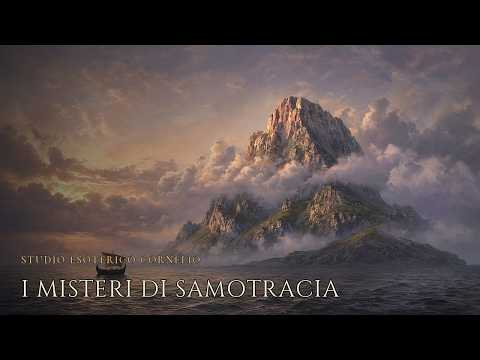
Samothrace is a mountainous island of the northern Aegean, hard to reach and often lashed by a violent wind. Yet for centuries it was one of the most visited religious destinations of the Greek world. Its sanctuary kept cults that the faithful spoke of with reverence and about which, as at Eleusis, they were to reveal nothing: the mysteries of the Great Gods.
Gods without a name
Who were they? Inscriptions simply call them Theoí Megáloi, Great Gods. Ancient writers identify them with the Kabeiroi, mysterious gods linked to fire and seafaring, or with the Dioscuri, protectors of sailors. A scholium on Apollonius of Rhodes' Argonautica gives four exotic names — Axieros, Axiokersa, Axiokersos and Kasmilos — explained as equivalents of Demeter, Persephone, Hades and Hermes. The cult probably preserved names and formulas from a pre-Greek language, which went on being used in the rites on the island for a long time.
Open to all
Unlike Eleusis, the mysteries of Samothrace had no fixed season: one could be initiated at many times of the year, and the sanctuary welcomed men and women, free and slave, Greeks and foreigners. Here too initiation had two grades, myesis and epopteia. Between the two, it seems, the candidate had to answer a question: what was the most serious wrong he had ever done. Plutarch reports an anecdote about the Spartan Lysander, who replied to that request by asking whether it was the priests or the gods who wanted to know.
Protection at sea
The most concrete promise of the Great Gods concerned seafaring: initiates believed themselves protected in storms. The offerings left by rescued sailors were so many that an ancient philosopher, looking at them, is said to have remarked ironically that there would have been far more if those who drowned had been able to leave theirs too. Initiates perhaps wore a ring of magnetised iron: Lucretius mentions the Samothracian rings lifted by the lodestone.
Philip and Olympias
The sanctuary had very close ties with the Macedonian dynasty. Plutarch tells that the young Philip, future father of Alexander the Great, met the princess Olympias at Samothrace when both were initiated there. Alexander's successors vied with one another to enrich the sanctuary with monumental buildings. Queen Arsinoe II had the largest roofed rotunda of the Greek world built there, the Arsinoeion.
The buildings of the rite
Excavations, carried out for many years by New York University under Karl and Phyllis Lehmann, have brought to light an extraordinary complex: the Hieron, where the epopteia probably took place, the Anaktoron for the first grade, a hall for ritual dances, theatres, porticoes, fountains.
The Winged Victory
The most famous find from Samothrace has nothing to do with the rite: it is the Nike, the Winged Victory, found in fragments in 1863 by the French diplomat Charles Champoiseau. It stood on the prow of a marble ship, in a fountain overlooking the sanctuary, perhaps to commemorate a naval victory. Today it greets visitors at the top of the great staircase of the Louvre, its wings spread against the wind that, on the island, has never stopped blowing.
Watch the video
Sources and further reading
- Herodotus, Histories II 51
- Plutarch, Life of Alexander 2
- Plutarch, Sayings of Spartans
- Diodorus Siculus, Library of History V 47-49
- Lucretius, On the Nature of Things VI 1044
- K. Lehmann, Samothrace: A Guide to the Excavations and the Museum
- S. G. Cole, Theoi Megaloi (1984)
Read next
The Telesterion of Eleusis
The great hall of initiation: a unique building in Greek architecture, designed not to house a god but to hold thousands of people and to keep a secret.
The Villa of the Mysteries in Pompeii
A suburban villa buried by Vesuvius and a cycle of life-size frescoes that has divided scholars for a century: a Dionysian rite, a preparation for marriage or a female initiation?
The mithraea of Ostia
In Rome's harbour town archaeology has uncovered almost twenty mithraea: the mosaic of the seven grades of Felicissimus, the seven spheres, the seven gates. The best place to understand how the cult of Mithras was lived.
