
Places and sanctuaries
The mithraea of Ostia
In Rome's harbour town archaeology has uncovered almost twenty mithraea: the mosaic of the seven grades of Felicissimus, the seven spheres, the seven gates. The best place to understand how the cult of Mithras was lived.
Ostia, the port of Rome at the mouth of the Tiber, is the ancient city with the most mithraea per square kilometre. Twentieth-century excavations identified almost twenty of them, set up in warehouses, baths, houses and barracks, nearly all from the second and third centuries AD. No other place shows so clearly how the cult of Mithras fitted into the life of a commercial town.
A city of mithraea
The worshippers of Mithras were men: merchants, freedmen, harbour officials, soldiers, firemen from the local barracks. They met in small groups, rarely more than thirty or forty people, and each group had its own mithraeum. That is why there were so many: not great temples but neighbourhood halls, often fitted into existing rooms and sometimes below street level, to recall the cave where Mithras had killed the bull.
What a mithraeum looked like
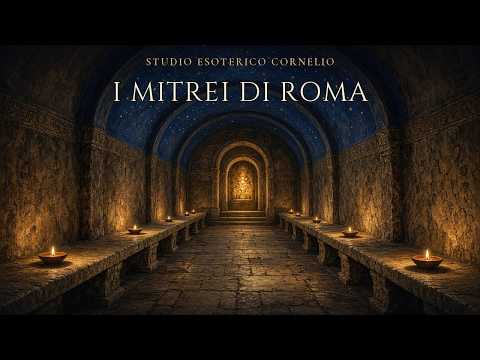
The plan is always the same: a long narrow hall with two masonry benches along the sides, where the faithful reclined for the sacred banquet, and at the far end the image of Mithras slaying the bull, carved or painted. The philosopher Porphyry explains that the Mithraic cave was an image of the cosmos, and at Ostia this can be seen clearly.
The mosaic of Felicissimus
In the mithraeum named after Felicissimus, the donor who had it decorated in fulfilment of a vow, the floor of the nave is divided into panels that follow one another like the steps of a ladder. Each bears the symbols of one of the seven grades of initiation and of the planet that protected it: the Raven and Mercury, the Bridegroom and Venus, the Soldier and Mars, the Lion and Jupiter, the Persian and the Moon, the Sun-runner and the Sun, the Father and Saturn. Walking towards the image of the god, the initiate retraced his own ascent.
Seven spheres and seven gates
Other mithraea reinforce the same idea. In the Mithraeum of the Seven Spheres seven arcs painted on the floor represent the heavens of the planets, and the signs of the zodiac appear on the benches. In the Mithraeum of the Seven Gates a painted wall with seven openings evokes the passages the soul has to cross. In the Mithraeum of the Baths of Mithras, finally, stood a marble group of Mithras slaying the bull signed by an Athenian sculptor, Kriton.
Visiting Ostia
Many mithraea can be seen in the Archaeological Park of Ostia Antica, some only on special occasions. Visiting them after reading about the cult of Mithras helps one understand how concrete a religion was that we know almost only through archaeology: worn benches, lamps, altars, images painted for a few dozen people who shared a secret.
Watch the video
Sources and further reading
- G. Becatti, Scavi di Ostia II. I mitrei (1954)
- M. Clauss, The Roman Cult of Mithras (2000)
- R. Beck, The Religion of the Mithras Cult in the Roman Empire (2006)
- Porphyry, On the Cave of the Nymphs 6
- Archaeological Park of Ostia Antica, official website
Read next
The Telesterion of Eleusis
The great hall of initiation: a unique building in Greek architecture, designed not to house a god but to hold thousands of people and to keep a secret.
The Villa of the Mysteries in Pompeii
A suburban villa buried by Vesuvius and a cycle of life-size frescoes that has divided scholars for a century: a Dionysian rite, a preparation for marriage or a female initiation?
Samothrace and the Great Gods
A sanctuary on a windswept island, gods with mysterious names, initiations open to all and a promise for seafarers: the second great mystery of the Greek world.
