
The cults
The Cult of Mithras
A god who slays a bull in a cave, seven initiatory grades and hundreds of underground shrines: the cult that spread among soldiers, officials and merchants of the Roman Empire.
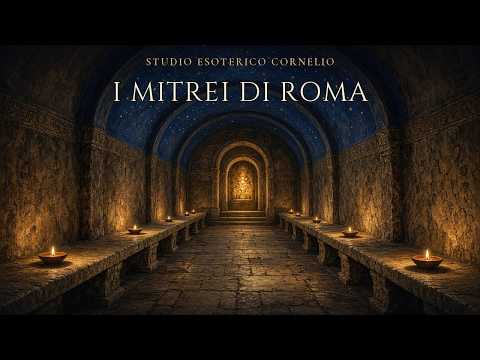
Going down a few steps beneath the basilica of San Clemente in Rome, past an older church, you reach a low vaulted room with two stone benches along the walls and an altar in the middle. It is a mithraeum, a sanctuary of the god Mithras. In the second and third centuries the Empire was dotted with them: from Britain to the Danube, from the barracks of the Rhine to the ports of the Mediterranean.
A Persian god?
Mithras is a very old name: it appears in Indian and Iranian religious texts as the god of the covenant and of light. For a long time scholars, following the Belgian Franz Cumont, thought the Roman cult was the continuation of the Persian one. Today another reading prevails: the mysteries of Mithras were probably a new creation, born between the first and second centuries AD, which used an oriental name and aura to build an original religious system. The debate is still open.
The bull scene
In every mithraeum, on the back wall, there was the same image: the tauroctony. Mithras, in a Phrygian cap and billowing cloak, pins a bull to the ground and stabs it in the neck. Around him appear fixed figures: a dog and a snake reaching for the blood, a scorpion seizing the bull's genitals, a raven, two torchbearers — Cautes with his torch raised, Cautopates with his torch lowered — and above them the Sun and the Moon. Ears of wheat sometimes sprout from the bull's tail.
Its meaning was explained only to initiates, and we can only reconstruct it. Some scholars have read it as a map of the sky, with figures matching constellations; others as a story of salvation in which sacrifice produces life.
The cave of the world
The philosopher Porphyry writes that Mithras had consecrated a cave as an image of the cosmos, and that for this reason his followers celebrated their rites in rooms that imitated a cavern. Mithraea were often underground or half underground, with stars painted on the vault. On the side benches the faithful reclined for the sacred banquet, which recalled the meal shared by Mithras and the Sun.
Seven grades
Initiation was a ladder. Jerome, in a letter, lists the grades, which are confirmed by the mosaics of Ostia: Raven, Bridegroom, Soldier, Lion, Persian, Courier of the Sun, Father. Each grade stood under the protection of a planet and had its own symbols. Tertullian describes a test of the Soldier grade: the candidate was offered a crown on the point of a sword and had to refuse it, saying that Mithras was his crown.
The cult was reserved for men. Communities were small — a mithraeum seldom held more than a few dozen people — and mixed imperial slaves, freedmen, soldiers and officers.
The mithraea of Italy
Italy preserves some of the finest sanctuaries. At Ostia nearly twenty have been identified, among them the Mithraeum of Felicissimus with its mosaic of the seven grades. At Santa Maria Capua Vetere and at Marino, in the Alban Hills, frescoes of the tauroctony survive with their colours still bright. In Rome, besides San Clemente, the mithraea of Santa Prisca and of the Circus Maximus can be visited.
The end
At the end of the fourth century, with the Theodosian laws against pagan cults, the mithraea were closed, destroyed or filled in. Many were covered by churches, and that is precisely why some have survived: sealed underground, they waited for centuries for the light to return.
Watch the video
Sources and further reading
- Porphyry, On the Cave of the Nymphs 6
- Jerome, Letters 107, 2
- Tertullian, On the Crown 15
- F. Cumont, Les mystères de Mithra (1900)
- M. Clauss, The Roman Cult of Mithras (2000)
- R. Beck, The Religion of the Mithras Cult in the Roman Empire (2006)
Read next
The Eleusinian Mysteries
The most famous mystery cult of antiquity: Demeter and Kore, the Sacred Way, the Telesterion and a secret kept for almost two thousand years.
Orphism
Orpheus, the singer who moved the stones, and a religious movement that taught the immortality of the soul: from the gold tablets of Magna Graecia to the Derveni papyrus.
The Mysteries of Dionysus
The god of the vine, of the mask and of sacred madness: bands of bacchants, Dionysian initiations and the Bacchanalia scandal that shook Rome in 186 BC.
